The gesture and what it asserted
In 1913 or thereabouts — the exact moment is uncertain, and Duchamp later gave several accounts — Marcel Duchamp mounted a bicycle wheel upside down on a kitchen stool. He did not call it art immediately. The object sat in his studio. He turned the wheel occasionally because he found the motion pleasant. What mattered was what came next: the decision, eventually, to frame the category. When he placed a commercial bottle-drying rack on the floor and, in 1917, submitted a factory-made porcelain urinal titled Fountain to the Society of Independent Artists exhibition in New York, the claim sharpened into something that could be debated. The claim was this: the artist's act is selection, not fabrication. The hand that signs the invoice is as legitimate as the hand that holds the brush.
Fountain was rejected by the exhibition committee despite the show's stated policy of accepting all entries for a fee. The object itself was lost, or possibly destroyed. What survived was the argument, and a photograph taken by Alfred Stieglitz made after the committee had rejected the work, and published soon afterwards in The Blind Man. The image showed the upended urinal in front of a Marsden Hartley painting, an arrangement Stieglitz composed with care — which is already a small irony: a photograph of a readymade, itself carefully made.
Selection as authorship, context as transformation
The philosophical load the readymade carries is not really about the object. It is about the frame around the object — the institutional frame, the conceptual one, the spatial one. Duchamp's word for it was readymade, an English term borrowed from American garment-trade language meaning something produced in standard sizes and sold off the shelf, as opposed to bespoke. The word does real work: it pins the argument to manufacture, to interchangeability, to the absence of the craftsman's individual touch. A mass-produced object is by definition one that has no single author in the traditional sense. Duchamp's intervention was to restore the question of authorship at a different level — not who made the thing, but who chose it, renamed it, placed it, and said here.
The title mattered too. In Advance of the Broken Arm (a snow shovel, 1915) acquires something — not quite meaning, but a drift of potential meaning — from its name alone. The object does not change; the linguistic frame does. Later Duchamp distinguished between readymades proper, which were unmodified, and rectified or assisted readymades, which had been altered slightly. L.H.O.O.Q. (1919) is a reproduction of the Mona Lisa with a pencil moustache and goatee added, and a title that spells out an obscene pun when read aloud in French. The alteration is minimal; the deflation of high culture is total.
What the readymade forced onto the table was a question that institutions had been quietly avoiding: if art is whatever the art world designates as art, who does the designating, and by what authority? The Society of Independent Artists committee that rejected Fountain answered inadvertently by their rejection — they were designating all along, simply in reverse. Duchamp had called their bluff.
The implications ran forward through the century. When artists in the 1960s began sending work to fabricators by specification rather than hand, or when the certificate of authenticity became, in some practices, the work itself, the logic was already present in the 1917 urinal. You do not need to make a thing to own the idea of it. What you need is the context that holds the claim, and the claim has to be made only once to stay made.
Chronology
- c. 1913Bicycle wheel on stool; not yet named or exhibited
- 1915In Advance of the Broken Arm (snow shovel) made in New York
- 1917Fountain submitted to and rejected by the Society of Independent Artists, New York; photographed by Alfred Stieglitz
- 1919L.H.O.O.Q. produced in Paris
A mass-produced object is by definition one that has no single author in the traditional sense.
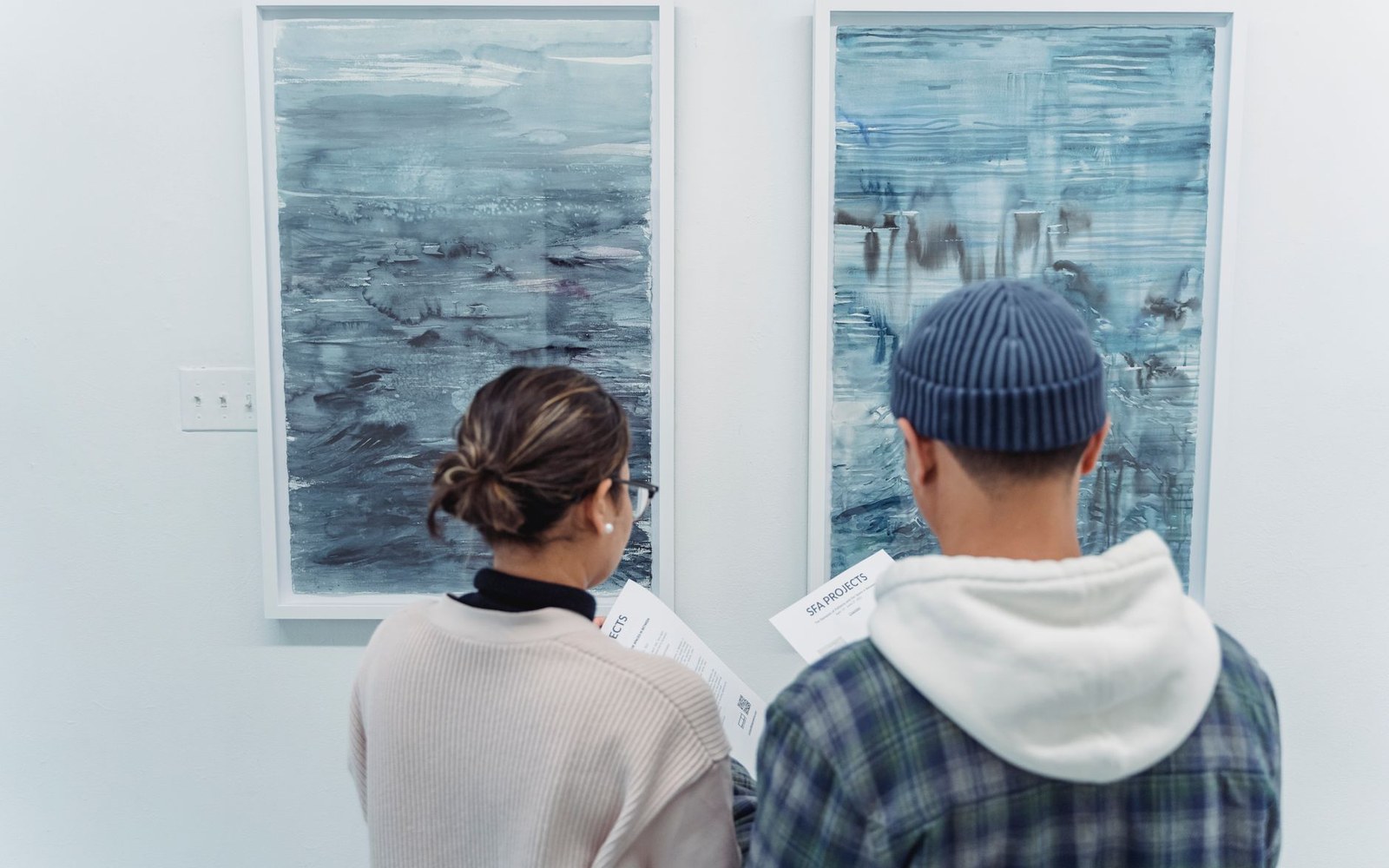
Standing distance is part of the work: a canvas sized to the wall asks the body to move back until the picture resolves.
Photo: Greta Hoffman / Pexels
Terms in use
- Readymade
- Duchamp's term, borrowed from American garment-trade English, for an unmodified commercially manufactured object selected and designated as art
- Assisted readymade
- a manufactured object that has been slightly altered by the artist; L.H.O.O.Q. is the standard example
- Rectified readymade
- Duchamp's term for the same category of altered object; used interchangeably with "assisted"
Where the sources disagree, this entry sets the disagreement out rather than resolving it. Nothing here is ranked as greatest or most important; corrections are welcome and are logged at the foot of the entry they change.